You can’t make this up!
I was checking out a documentary called The Lynchpin of Bensonhurst.[1] It’s a long story why, but I was brought up in that neighborhood. It was the story of Dominick Santamaria aka Dominick Montiglio, an important member of the Gambino crime family who was brought up by his uncle Nino Gaggi. Nino was arguably the most notorious capo of the Gambino family.
I only needed to check out something in the first few minutes, but something caught my eye and that impelled me to explore further.
As the map displayed in the documentary zoomed in on his birthplace, first you see New York City, then the borough of Brooklyn, and finally Bensonhurst, my neighborhood. The arrow on the screen then zeroed in on a video scan of the block Dominick grew up with its three-family attached brick houses. Suddenly, I then saw my house just two doors down from where Dominick Montiglio lived!
When my older brother watched the documentary, he was shocked. Dominick was his best friend until our family left the neighborhood when my brother was ten. Dominick never showed signs of psychotic or sociopathic behavior. He and my brother never did anything remotely violent or anti-social. In fact, they loved each other as best friends.
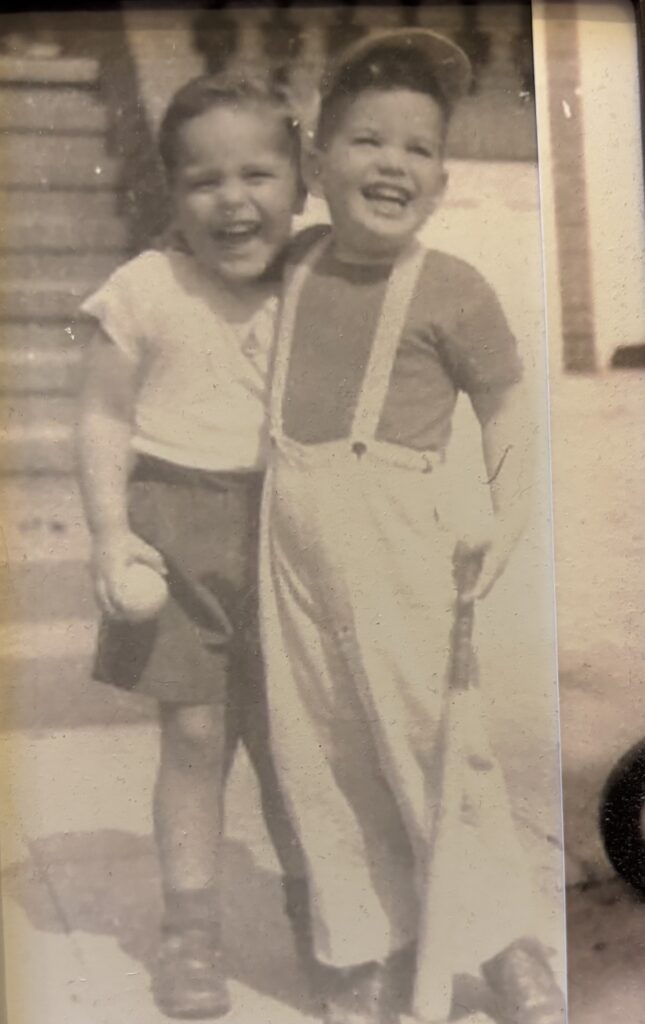
To give a little more context to this post without going into much detail, I will just mention one thing about Dominick’s life from that documentary. It highlights a little why my brother, a “never hurt a fly” kind of guy, was shocked so much.
As Nino Gaggi was the surrogate father of Dominick after his father left, eventually Dominick became closely involved in nearly all facets of his uncle’s criminal activities. Three times a week while he was on mob business for his uncle’s loan-sharking business, he visited and hung out at the Gemini Lounge. The lounge was the center of what has come to be known infamously as the “Murder Machine,”[2] a social club for arguably the deadliest hitmen in the history of organized crime.
One thing struck me strongly about Dominick’s story. Certain influential factors are essential to socialize members of society towards a particular objective.
Unfortunately, in Dominick’s family, the goal was perverse. Dark factors therefore worked to transform our childhood friend, a basically good-natured and seemingly stable young boy, into a person who acquiesced to evil.
It highlighted for me, of course, the importance of these influences when used properly in transforming a society or an institution into a spiritual one.
Two factors highlighted in the film stuck out — the power of tradition and the influence of association. I will just focus on the first. In the future I may cover the other.
When a child is born into a society with a strong tradition of certain values, he is very likely to follow them. Dominick comments:
“My family goes back centuries in Sicily and they were always criminals. I knew no matter what, I was going to get sucked into that life. I did the music thing, I went to college, but I always knew in my heart if I didn’t do the family thing, I was letting them down.”
From the film here is just one striking example of the influence of his family tradition on him:
“When I was eight or nine, I was very popular with the other students and the teacher. I was made class president, so I proudly told that to my uncle. When he asked what that means, I explained that my main duty was to write the names on the black board of anyone who was disrupting the class, or especially harming others.
“‘Oh, a snitch,’ he replied. ‘We don’t do that!’ Sadly, the next day I had to tell the teacher that my family said I couldn’t be class president.”
My thought: Unless the Krishna consciousness movement develops a tradition that inculcates its values through generations, we seriously risk failing to maintain Śrīla Prabhupāda’s legacy. Even newer members require such an established and firm tradition to help them remain steady on our path.
We were shocked when we found out about Dominick’s life. But even in the documentary you could strongly see the spark of humanity in him that got covered over.[3]
So, in a sense that’s what I learned from my association with the Gambino crime family!
[1] The Lynchpin of Bensonhurst — https://www.youtube.com/watch?v=TRK86DqJfA8
[2] Murder Machine: A True Story of Murder, Madness, and the Mafia — https://www.amazon.com/Murder-Machine-Story-Madness-Mafia-ebook/dp/B01BOEIOK8
[3] If this was a long treatise I would have loved to have analyzed Dominick along the lines of what Hannah Arendt described in her book Eichmann in Jerusalem: A Report on the Banality of Evil. The “banality of evil” does not mean evil is trivial. Rather, it means that horrific crimes can arise from thoughtlessness, conformity, obedience, and the abandonment of personal judgment within powerful systems and institutions. I think such points also serve as a caution to spiritual institutions.