Monday Morning Greetings 2022 #26 – The Process of Writing and Other Thoughts

June 27th, 2022

I got positive feedback from my last post—that the message was succinct and profound. It is always edifying to be encouraged. “Die to Live” was a simple offering of 500 words, but simple it was not. Finishing it was excruciating. I almost gave up many times. My “pen” finally rested Sunday night.


There is no rest for the wicked[1]. Today I began again to write the next post, but what to write? I had no idea. I chanted and prayed. An inspiration came: You struggled last week, so why not share your process of writing?


Inspiration


Writing begins with an inspiration. Without having some realization to write about, the “pen” can’t move forward. A realization is a vision of truth, a conception that is not just understood, but an epiphany—something that is seen. My faith is that wisdom texts and spiritual practice gives one the lens to get those glimpses of realization, those visions of truth. I believe that most of us have more of those “epiphanies” than we realize. They are often fleeting and gone before we even realize that we have them. A commitment to writing keeps us ready for them so that when they flash by, they can be noted and recalled, just like dreams are usually only remembered when we make the conviction to write them down upon waking. Realizations may not come often, but I seem to get at least one per week to write about. When I do get one, I start the “pen” moving, or I jot down those writing realizations for the future. The test of a realization is the ability to communicate it. If the realization is deep enough, the whole article is sometimes practically seen before I write it and does not take long, but when the realization is not deep, like last week, only the demand of writing that realization will force me to understand the point clear enough to be able to communicate it effectively, and that sometimes takes time.


Faith


To have an inspiration is one thing. To be able to mold or communicate your inspiration in a literary form so that your audience can appreciate or even experience what you have realized is another thing. Often, when starting, the task seems daunting. It is easy at that time, or at any other point in the writing journey, to give up. One needs faith to move forward.


The first conviction that pushes me forward is just the simple realization that if I never start, I will never finish. The saying I quoted from my post two weeks ago on Chinese proverbs must be firmly internalized by every writer in this regard:


Don’t believe you will ever reach the destination without leaving the shore.


Leaving the shore in writing means writing even one sentence. That exercise alone activates the mind in amazing ways, and a lot of the quandaries in conceptualizing and expressing your point will then go on in the mind off page and even subliminally.


My faith that my initial inspiration will manifest into the proper expression of it is further fortified by my experience. What’s my experience? I have been writing one article a week for six and a half years. Often, even usually, when I begin the task to mold my inspiration into something of substance, I can’t imagine succeeding, but my “trust by experience”—my favorite definition of faith—is that when I commit to a certain number of hours of writing by the end of the week, the result inevitably comes by Krishna’s grace.


And that is another important factor in giving me the confidence that I can complete a post of quality every week—my faith in Krishna, or God. If one is given a service for Krishna, the empowerment to execute it no doubt comes with it. I see no other reason why I have been able to write articles that have maintained the interest of my audience for so long, as I was never a writer growing up, or in the first twenty-five years of my service in ISKCON. So, in that sense, I do not feel it is me writing. I just do my service and leave the result to Krishna. The focus on service, rather than result, inspires me to write without fear or angst and is an important element in my process of writing.


Focus


Now, on to the technical process of my writing. Over thirty years ago I took a course in the VIHE[2] on clear thinking and strong speaking given by Śrīla Prabhupāda’s personal editor, Jayadvaita Swami. The course also discussed good writing. What I took away from the course more than anything else is that good speaking and writing must have a focus—one idea or theme that unifies every paragraph and page. I loved the “so what” exercise, where you go through every paragraph of writing and ask that question. If you can’t answer it affirmatively by connecting the paragraph you have written to your theme and the flow of your article, you either must hone that paragraph so it does, or delete the paragraph as irrelevant.


This is how I specifically apply that process. My theme is my inspiration or realization. I continue writing as long as I feel my theme is focused and logically progressing from the previous paragraph. When I get stuck and I just can’t figure out how to proceed, I have the luxury of going back to the very beginning of my article to hone my writing from the very first sentence, as my posts are rarely more than a thousand words. As what I have written so far has been relatively focused, going over the article again really sharpens my realization of the theme and refines my logical expression of it. When I then get to the part where I am stuck, I usually have a much better idea where I should be proceeding to keep it focused. It may take deep thought to figure that out, but at least I now know what I must do to keep it focused. If it is still difficult to proceed, I will go back to the beginning and start again, even rereading the piece several times to help overcome that one place where I am stuck. Sometimes by doing so I realize that I have not understood my focus or theme clearly enough and must rewrite several paragraphs. So, if you appreciate that my articles are succinct and focused, then the wisdom of the French philosopher Pascal is relevant: “I would have written a shorter letter, but I did not have the time.” In other words, I take the time to write it. Ironically, this week my article is a bit long. Due to extenuating circumstances, I didn’t have the time I wanted to write it. And there is still more.


It is Sunday morning, I have about a half hour to finish this because I still must chant more, prepare for my Sunday class, give the class, and then leave for a program and head Upstate. Before sitting down to write, I took a bit of a power walk and chanted for a half hour, as I usually do upon rising. I was trying to concentrate on the mantra, but some thought came about the first verse in the Tenth Canto, which I am teaching now. It was an epiphany, as I have never read what I saw before in that first verse. It is also the inspiration or realization I needed for my next Monday Morning Greeting.


What I found especially edifying about this realization was the fact of having that realization alone was the perfect way, in my opinion, to accomplish the last two things I needed to finish this post before getting it to my editor in about a half an hour–to discuss the importance of a good ending that summarizes the theme and to have a good ending.


A good ending highlights your theme and brings you full circle back to the introduction of your article, which hopefully had outlined your theme in an interesting way. My theme was about my process of writing, which centers on elucidating clearly a realization or inspiration. My article began by discussing the interesting way I gained the realization to write this post, so it is quite apropos to end with the interesting way I got the inspiration to write the next one, which highlights my theme—the process of writing that focuses on an inspiration to be communicated. That the inspiration for writing in both cases came so suddenly also highlights to me the most important part of a Vaiṣṇava’s process of writing, and certainly mine, and how this whole article, and every article I write, begins:


“I am seated in everyone’s heart, and from Me comes remembrance, knowledge and forgetfulness.” (Bg. 15.15)


[1] This saying originates from a Biblical verse (Isaiah 48:22). In the modern context it is used as a simple way to say one is always busy.

[2] Vrindavan Institute for Higher Education
 

Monday Morning Greetings 2022 #25 – Die to Live

June 20th, 2022

Die to Live[1]


Last Saturday I met my swami friend, Kadamba Kanana Maharaja. He was chanting and dancing enthusiastically at the Ratha-yātrā festival for hours and hours, but his prognosis is not good. His cancer has metastasized. He will leave soon for Vrindavan to prepare for the final journey. Our prayers are with him.


Naturally that got me thinking about death, but I felt foolish: Why do I need someone dying to get me thinking about death? What can be a starker fact of life? Such obliviousness is especially unbecoming for me, a sannyāsi, a monk.


The whole idea about the renounced order is that it is a stage of life where one is supposed to “die to live”, an interesting paradox that highlights why it is so inappropriate for a sannyāsi to lose that sense of the ever-present world of death. This becomes clear when one understands what death really is.


Death, or the phrase “die” as used in the paradox, does not refer to the point where the body no longer has life, because the end of the body is not the end of life for the eternal soul. Rather, “die” signifies the real part of us that is meant to die, the ego—the misidentification of the eternal self as the body, which subjects us to the terrifying but illusory threat of non-existence commonly called death. A monk must therefore keep himself aware of bodily death to maintain the inspiration for the continuous dissolution of the pernicious ego, the ultimate cause of death. Why then when a friend has a terminal disease should it have been an epiphany for this monk?


One point here still needs to be clarified. Although the traditional sannyāsa method of dissipating the ego by the abject renunciation of all bodily desires and identification is not for everyone, the awareness of death and the inspiration it gives to transcend the false concept of the self is for all spiritual aspirants. Only the tact or method of doing so, may vary. For bhaktas, instead of abject renunciation, we starve the ego by neglecting the impulses of selfishness through full dedication to our duties and service to Krishna. This type of ego death is described in a beautiful Eleventh Canto commentary where the tapasya (austerity) for a Vaiṣṇava is described:


“Tapaḥ, or ‘austerity,’ means that despite the irrational impulses of the mind one should remain fixed in executing his proper duty in life.”[2]


This may seem to be a gentler ego death than merciless renunciation, but it is not easy, no matter what one’s station in life is, to have the integrity to live by what’s right rather than just what we, the concocted self, want—especially if one adds a commitment to the practices and mission ordained by a spiritual preceptor. But what choice do any of us have in facing the reality of “death”, but to begin in some way the practice of dying to live.


[1] “Die to Live” is an expression that Śrīla Bhakti Rakṣaka Śrīdhara Mahārāja borrowed from the German philosopher Georg Hegel to describe how when the ego is dissolved our eternal nature remains.

[2] Bhag. 11.3.24, purport


Monday Morning Greetings 2022 #24 – A Personal Commentary on Chinese and Brooklyn Proverbs

June 13th, 2022

A Personal Commentary on Chinese and Brooklyn Proverbs[1]


April 16, 2018

By chance, I came across a book of Chinese proverbs.[2] Out of curiosity, I began thumbing through the pages and wound up reading the whole thing. I’m glad I did. A quote by Francis Bacon in the introduction says it all:


“The genius, wit, and spirit of a nation are discovering proverbs.”


Here are a few of my favorites, with short personal comments on each:


Chinese Proverbs


Only one who can swallow an insult is a man.

A real man is one who has the strength of humility to control the false ego, which especially gets stirred when one is insulted.


Do everything at the right time and one day will seem like three.

To do everything at the right time means to be thoughtfully regulated in one’s activities. Making appointments with oneself helps to inoculate one from the intrusion of other less essential demands made by our minds and by others. So much can be accomplished when one does this. For example, if one wants to maintain or increase one’s chanting, then one should chant every day at a prescribed time. Every three rounds will seem like one.


Patience in one minute of anger can prevent one hundred days of sorrow.

Too much of life is wasted in dealing with problems that one has brought upon oneself by reacting impulsively. In other words, too much of what we are dealing with is self-created and could be avoided if we had more self-discipline and thoughtfulness.


There are two kinds of perfect people—those who are dead, and those who have not been born yet.

The only way not to make mistakes is to do nothing. If we sincerely endeavor to improve ourselves, even if we sometimes falter, there is no reason to feel guilty.[3]


Men will despise you only if you despise yourself.

Unfortunately, low self-esteem projects weakness and attracts scorn from those who are weak and envious. In contrast, those who feel self-worth as pure, humble servants of God attract affection from all. Srinivasa Acarya describes this about the Six Gosvamis of Vrindavan:


“They are just like the ocean of love of God, and they are popular both with the gentle and with the ruffians, because they are not envious of anyone.” (Ṣaḍ-gosvāmy-aṣṭaka 1)


To be fond of learning is to be near knowledge.

Our present knowledge is limited by our present frame of reference. There is so much more to know than what we can presently understand just by our perception. Therefore, in terms of nearing knowledge, without eagerness to learn from a teacher—an authoritative source—one is doomed either to be stuck where one is or to learn very slowly.


Only by learning do we discover how ignorant we are.

Only by learning a subject can we understand the subject’s depth—especially spiritual subjects. For example, God is infinite. Thus, the more we learn and realize about the expanse of God’s glories, the more we discover how much more there is to know.


Better to argue with a wise man than prattle with a fool.

Next time you engage with or even just follow a Facebook thread, keep this advice in mind.


To know another person is not to know the person’s face, but to know the person’s heart.

The most substantial part of any person, which is one’s nature as a friend, parent, or lover, is revealed to a person only by those who love him or her. It can never be seen by perception or analysis alone. Similarly, God can be known only when He becomes inspired to give Himself in reciprocation with one’s devotion. Sri Krishna describes this principle in the Bhagavad-gītā: “To those who are constantly devoted and worship Me with love, I give the understanding by which they can come to Me.” (Gītā 10.10)


Learning is like rowing upstream: to not advance is to fall back.

If one is not steady in one’s commitments in spiritual life, one will not gain the strength to move forward. Enthusiasm wanes for any endeavor in which one does not feel progress.


Only distance tests the strength of horses; only time reveals the hearts of man.

Many people at the beginning of their spiritual life practice at a level beyond their qualification due to their initial fervor, but as their motive is not yet pure, they often become slack in their practices. The real test of one’s devotion is when one steadily executes their service for many years despite the challenges that come over time. We should very much respect those devotees who, after decades of facing life’s natural “ups and downs,” are still steadily engaged in humble service.


I was angered, for I had no shoes; then I met a man who had no feet.

One should be content with one’s immediate needs of life. Accruing more than that will only increase one’s level of attachment, leaving one with the same level of dissatisfaction as before. According to the Yoga Sutras, the result of perfecting the niyama of contentment, this satisfaction with what one has, is the attainment of the highest happiness.


To know the road ahead, ask those coming back.

One of the six qualities that enhance bhakti is sadhu-vṛtti—to follow in the footsteps of previous acharyas. It is described that the footsteps of a sadhu are like so many lighthouses that help one cross an infinite ocean


A smile will gain you ten more years of life.

Many studies show that the single most important factor for physical health is not exercise or even diet, although they are certainly important. The single most important element necessary for a long life is the quality and amount of the good relationships one has. It is the key because it is the foundation of happiness and “a smile will gain you ten more years of life.”[4]


A book holds a house of gold.

The most valuable things we possess are life realizations, for only by seeing the truth everywhere can one become happy. Realizations come by applying what we have heard from books of knowledge. A book of true knowledge thus contains the greatest treasure.[5]


The beautiful bird is the one that is caged.

Opulence, whether it is beauty, wealth, fame, intelligence, or something else, can be used either to serve others or to control them. Unfortunately, because our desire to enjoy is so strong, we often see and use our “good karma” to control others, entangling us in the ropes of karma.


When drinking water, remember its source.

There are some things written on the subject of devotion that I don’t read even though they seem intellectually and aesthetically stimulating, because I doubt the character of the source. Whatever a person shares with conviction carries his or her heart. If a person’s convictions are jaded by an agenda, those misconceptions and feelings are subtly transferred into his or her writing.


Don’t believe you will ever reach the destination without leaving the shore.

When I begin writing Monday Morning Greetings each week, I can’t imagine that a finished article will be produced, but I realize that if I don’t start, I will never produce anything. Many talented people don’t write very much, because producing a written piece is daunting and they never start. If one leaves the shore of paralysis by simply vowing to write even a sentence or two a day, one will soon reach the destination of a completed piece.


I don’t have time to comment on all my favorites, so I will list the last few:


Listening well is as powerful as speaking well, and it is also essential to true conversation.

Disease enters through the mouth; disaster leaves from it.

Useless as a youth, useless as a man.

Learning that does not daily increase will daily decrease.

He who teaches for a day is my father for life.

Life is but a journey; death is returning home.


Brooklyn Proverbs

I have to admit, I put this in the title to make the article more attractive to read. But now I am forced to come up with at least one “Brooklyn Proverb.” I can think of only one, but it’s quite revealing about the culture I grew up in.


Nice guys finish last.

This was about as famous a quotation as there was when I was growing up in New York. It is credited to Leo “The Lip” Durocher, then the manager of the Brooklyn Dodgers professional baseball team.


[1] This article has obviously been reposted. I spent all last week writing an article for The Journal of Vaisnava Studies so I did not have the time to write a Monday Morning Greeting entry this week. I am, therefore, instead posting an article from four years ago. A reader recently commented to me that it must be an austerity for me to write a quality article every week. It certainly sometimes is, but I have to say, however, it’s not as much of an austerity now. I have become better and more efficient as a writer. Also If for reason there is some challenge to complete an article one week, I have the option go back almost up to seven years to find a relevant article to that many of my readers either haven’t seen before, or if they have, don’t remember. I hope you enjoy this one.


[2] Emil William Chynn, Chinese Proverbs for Today’s World.


[3] “Having awakened faith in the narrations of My glories, being disgusted with all material activities, knowing that all sense gratification leads to misery, but still being unable to renounce all sense enjoyment, My devotee should remain happy and worship Me with great faith and conviction. Even though he is sometimes engaged in sense enjoyment, My devotee knows that all sense gratification leads to a miserable result, and he sincerely repents such activities.” (Bhāgavatam 11.20.27–28)


[4] Robert Waldinger, What Makes a Life Good: Lessons from the Longest Study on Happiness.


[5] See “Be a Sage Page by Page” available on Apple App Store and Google Play.


Monday Morning Greetings 2022 #23 – Street Unicorns

June 6th, 2022

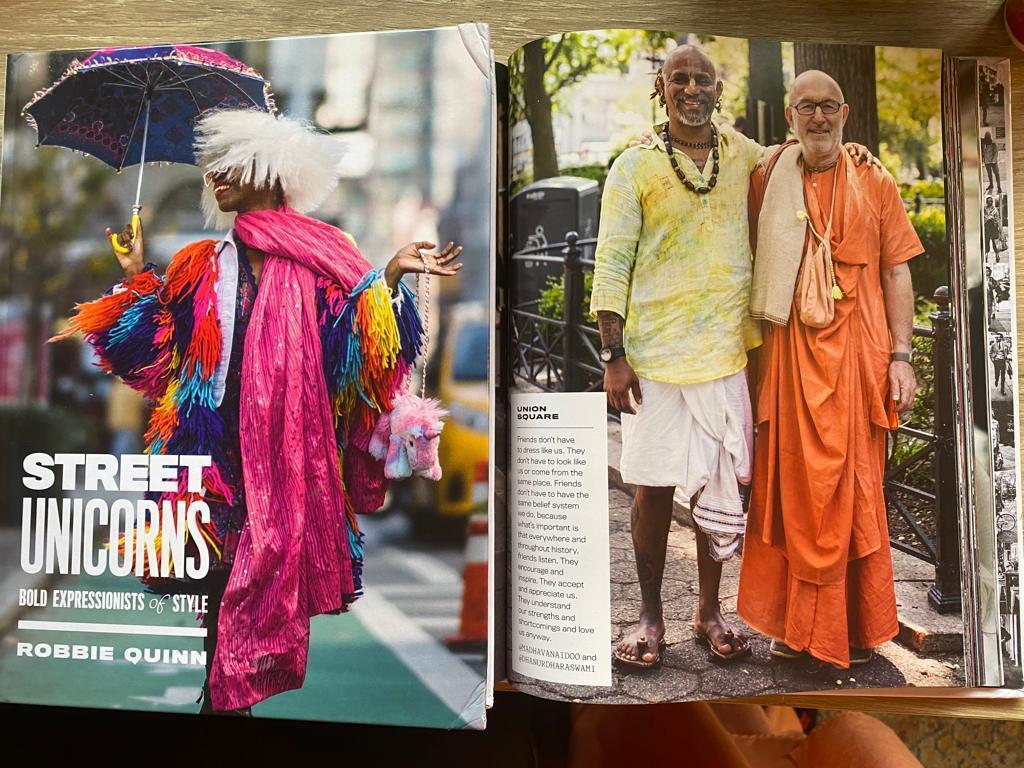
My mother was a fashion designer who prided herself in the clothes she designed and the dresses she wore, and her son comes home as a Hare Krishna dressed in shmatas! Yes, that’s the word she used to describe my robes. It is a Yiddish word for “rag” usually applied to shabby dress. Later, as I matured, I was more sensitive when visiting her. She much preferred the brightly pressed saffron silks than the crinkled faded cottons. “Oh beautiful,” she said, as she reached out from her seat to feel it’s fine texture and admire the bright saffron color. I think she would have been happy to see my picture in Street Unicorns.


Street Unicorns is a newly published coffee table book that highlights the dress of boldly stylish New Yorkers with the strong urge to express their authentic self in fashion, regardless of what people think. But what the hell am I doing in such a book?


Street Unicorns


It was a little more than two years ago, during a pleasant pre-COVID summer, while walking around Union Square Park with Madhava das during his break from leading kirtan with the harinama party, when we were stopped by a pleasant gentleman admiring our “unique” garb. He spoke something about a book he was writing, asked to take our picture, got our information, sincerely thanked us, and left. Soon we got documents describing in more detail his project and asking us to sign a release so that he could use our pictures. Two weeks ago, the book was released.


Robbie Quinn, the author, is an excellent photographer, and just as good a writer. Although it is not by any means my usual monk reading fare, I was impressed with the book. It was so well written that once I began skimming the three-thousand-word introduction, I was drawn to go back and read what the author was saying more carefully.


Mr. Quinn’s passion is authenticity, a quality he says that can often make people impelled to express themselves in ways that don’t conform to the crowd. He reasons that it is very difficult to do this in smaller, more provincial places that thrive on such conformity. He therefore appreciates New York City, where historically many new people arrive and those in residence get used to, and even welcome, others who are different than themselves. In his introduction, he describes this phenomenon and how it spurs creativity and why it inspired him to honor this expression of authenticity in fashion through his photography:


“It may sound counter-intuitive, but perhaps because there are so many new people coming to cities all the time, everyone seems to be more curious rather than suspicious of one another, Presenting yourself in a different way might not be judged as harshly, and there is already someone that gets you, somebody that feels something similar. An idea is shared, and movements born. This can happen with regard to music, fashion, and social issues—any situation where open minds can meet.”


I think you may all be appreciating this week’s post but may question what this has to do with my weekly blog, whose theme is wisdom based on the Krishna bhakti tradition. I just loved the picture from the book, and so did those few I shared it with. I felt that my readership would also, especially as it was with Madhava, who needs no introduction as arguably the most respected kirtan singer in the current international Krishna bhakti movement. Street Unicorns was my inspiration this week, and I felt inspired to write about the picture and see how I could fit it into my blog. Did I put the cart before the horse in the sense that due to my enthusiasm for the book, I began a post before I had some specific realization to share, while usually I start first with a specific realization in mind? The answer is yes, but I think it worked, and by telling the story of the picture something came within my mind to share. Here it is:


It is ironic that I am in a book of people who want to stand-out, because the saffron color of the robes of a monk is literally called “kasaya”[1], indicating freedom from dressing in a materially attractive way.[2]  My motive for dressing the way I do, in that sense, is exactly the opposite of a “street unicorn” as Robbie Quinn defines it: a bold person wanting to stand out and express their non-conformity. So rather than being a “street unicorn”, my simple robes are more a conformity and submission to a spiritual ideal than an expression of uniqueness. On the other hand, although it is non-descript, my dress expresses authenticity in another way. It is certainly an expression of the person I am or want to be—a dedicated servant of God who wants to exemplify and feel by his dress a life of simple living and high thinking.[3]


Now here is the irony: In another way, I do stand out by my dress, because the culture I am representing is transplanted here in the West. By wearing my robes, I am making a public statement that “I am different, this is who I am, come find out if you are interested.” This is what the first Hare Krishnas who came to England purposely did. They specifically shaved their head and wore robes, which they hadn’t done before, to stand out. They were successful beyond their wildest dreams. They stood out and attracted the curiosity of the Beatles, which led Apple Records to produce The Radha Krishna Temple album,[4] one of the songs which reached the twelfth most popular on the UK Billboard chart at the time.


I also related to Robbie Quinn’s description of New York, how it developed a culture of diversity and acceptance that fosters conversations with the curious and like-minded, which gives birth to trends and new movements like no other place in the world. When I read that, it highlighted in my mind the genius of Śrīla Prabhupāda coming to New York and why his movement started and flourished there. Hey, if I just wore slacks and a baseball cap how would Robbie have ever found me!


Let me end here with a corny finish—you know the ones where immediately after a loved one has died their adult child achieves some great accomplishment, usually winning a significant sporting event, and to honor the departed they sentimentally point to the heavens to offer their success to their loved one. Let me do that here for my mother, who died last September in her hundred and first year:


“Mama, look! Your boy who came to you in shmatas is now a fashion icon!”


[1] Kasaya or kashāya (Sanskrit: कषाय) means, ‘astringent’, ‘decay’, ‘smearing’, ‘juice’, ‘degeneracy’, ‘anointing’, ‘gum’, ‘resin’, ‘red-brown’, ‘stupidity’, ‘defect’, ‘fragrant’. It also means ‘attachment to worldly objects’ or to ‘the yellowish-red garments worn by monks’.

[2] “The kaṣāya, or saffron loincloth of a sannyāsī, indicates freedom from all attractive material garments.” (Bhag. 1.15.40, Purport)

[3] While visiting the Supersoul Farm in Upstate New York I met one lady named Sandy from Boston. I showed her the book and began describing it, and somehow she connected it to Bill Cunningham, a photographer she had admired. I found that interesting as the book was dedicated to him. Yesterday I got a note from Sandy that had similar realizations to me as to why my simple dress was a good fit for Street Unicorns: “I had a realization after I left that you might find interesting. The fashion book that you’re featured in…dedicated to Bill Cunningham…and about authenticity and style. Bill Cunningham only wore one outfit ever, which was the uniform of hotel cleaning staff, very humble garb. (He also lived in a tiny room with almost no belongings.) That bears resonance with the concept of spiritual dress: that is what is most authentic (and radical, in material culture) in not identifying with one’s outer layers.”

[4] https://en.wikipedia.org/wiki/The_Radha_Krsna_Temple_(album)