The Govardhan Hillton is a long story.
A generous donor sponsored the renovation of my ashram. My assistant, an engineering genius, supervised the work, and the donor gave him carte blanche to make it first class and highly functional. It is.
I was so impressed when I returned that I jokingly called the place the Govardhan Hillton. Unfortunately, the name is sticking.[1]
This week David, our devotee friend from the Samuel Platzer Co. diamond family in New York, is staying at the Govardhan Hillton. He generously offered to sponsor a pilgrimage to Jaipur for everyone here and put us up at the five-star Radisson Hotel Jaipur City Center, so we’d be near Govindaji for our daily parikramā. It was wonderful. The parikramā, that is.
So here I sit in my room at the Govardhan Hillton, clicking the AC thermostat every hour to suit my whims, just back from a luxurious stay in the business suite at the Radisson. And this is the same former sādhu who never had AC, who lived here for years without even hot water, and who for fifty years mostly endured the elements through the extremes of every season. Some sannyāsi! [2]
Oh, and I just took my clothes out of one of the four new washing machines!
Joking aside, I suddenly became worried. Is this any way for a sādhu to live?
Some of you reading this may find this humorous: “Don’t be silly. You need this for your service.”
Do I? Here are my concerns.
Human life is meant for tapasya. Tapasya doesn’t mean torturing the body; Krishna Himself condemns harsh austerities that aren’t recommended in scripture. It means a simple life of devotion that willingly accepts some discomfort, just enough to train us not to be ruled by the body’s demands. By tolerating heat and cold, happiness and distress, we learn in practice that we are not the body. But if we keep excessively adjusting our surroundings to suit the body, we strengthen the very identification we’re meant to give up, and the habit grows stronger over time. Then in old age, when the body can no longer be kept comfortable, it’s all we’ll be able to think about.
Of course, I can speak this way about tapasya because I’m very healthy for my age and I’m still capable of living a very simple life. Many of my godbrothers are not so fortunate. Having given their youth to ISKCON, they seem to have performed enough austerities for many lifetimes. Without apology, they need whatever adjustments to their environment are required to allow them to stay functional for service and to cope with old age and illness. I understand that.
Now, back to me.
I’m also concerned about how I should live if I want to keep residing in Vrindavan. Here is what I’ve observed from living here for most of the past fifty years. Visiting Vrindavan is one thing; residing here is another. Those who live here must be almost militantly — or better, spontaneously — committed to keeping Krishna at the center of their lives, and becoming excessively preoccupied with relieving one’s discomfort can undermine that commitment. I’ve noticed that those who build luxurious houses for themselves become uncomfortable in other ways, and they rarely stay. Vrindavan is for simple sādhus. If I want to remain here, I had better be one.
What to do?
Well, first, if everything is highly functional,[3] why shouldn’t I take advantage of that to be more efficient in service? I just have to be very careful to use only what is needed to keep body and soul together, remembering that the place has been upgraded primarily for the guests. They need these comforts for their short stay so they can perform the austerities of pilgrimage here.
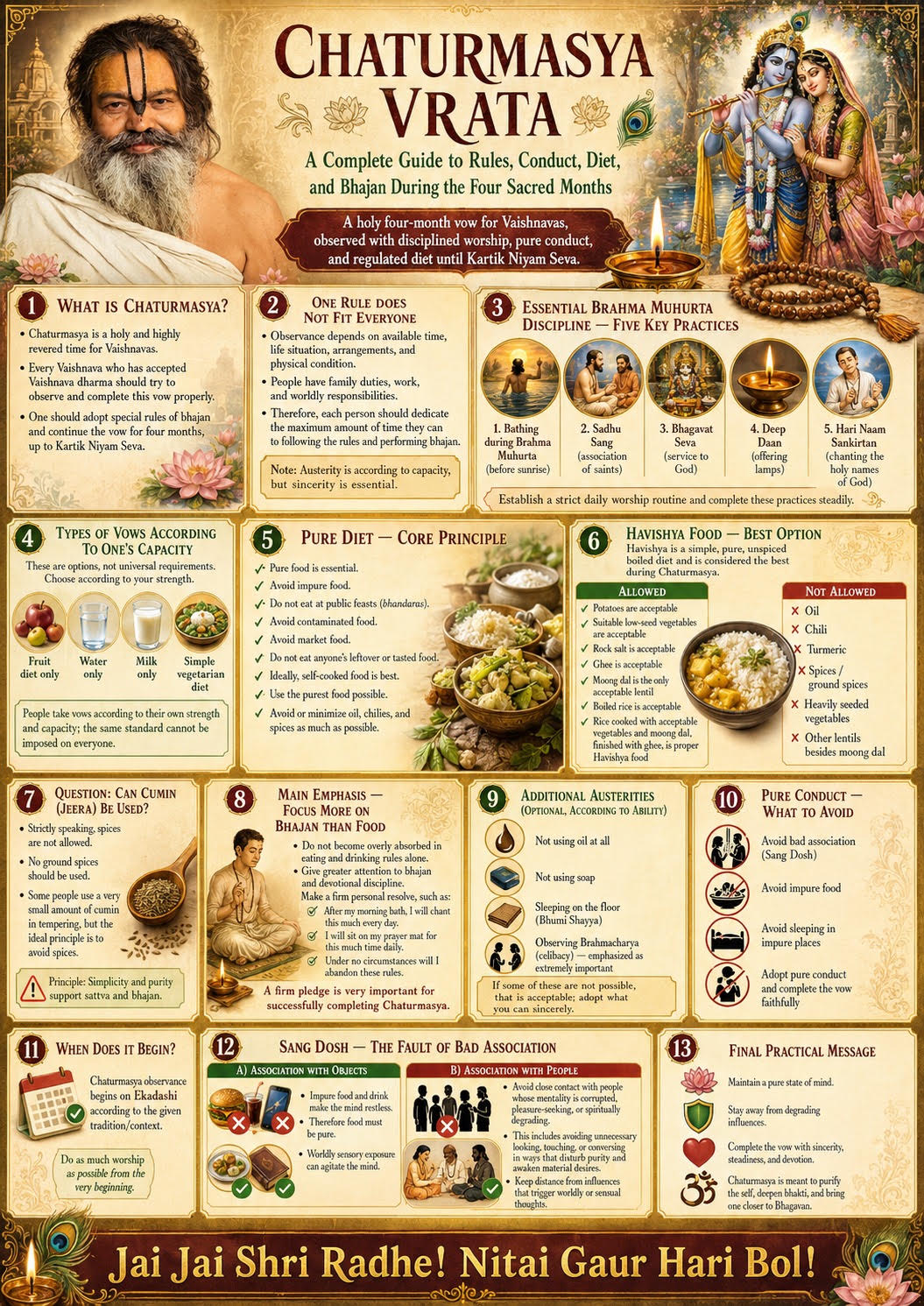
Still, to remain a sādhu here requires some tapasya. For a start, I’ve begun going around Govardhan religiously twice a week. Most important, I’m observing, as I do every year, niyama-seva for Kārttika.[4]
I remember visiting my family home in Brooklyn one summer after three extremely arduous years in Vraja, from 1976 to 1979. I doubt many reading this can imagine the austerities we were forced to perform. One day while I was there, my parents’ AC broke. It was nothing to me. I chuckled, though, at my New York Jewish mother’s immediate, dramatic, and entirely expected reaction: “I’m dying!”
As I write this, the thermostat on my AC has stopped working. “I’m dying!”
What has become of this simple sādhu?
[1] The actual name of our ashram is Sri Govardhan Bhakta Seva Ashram. I prefer to call it that, although for humor’s sake the pun Govardhan Hillton is fun.
[2] The word “some” is used sarcastically to mean the exact opposite of its literal meaning — turning a label of praise into an insult by emphasizing a noun that clearly fails to meet expectations.
[3] Highly functional means that there is 24-hour electricity off the grid sufficient for AC and heat. Every apartment has high-speed Internet, new kitchen, high end water filters, and new furniture and all wood termite infested door and windows have been replaced with high-quality PVC. I have never lived anything near like this in India.
[4] Here is a practical guide to Kārttika written by a renowned contemporary Vaiṣṇava — Chaturmasa Vrata Guide.