Monday Morning Greetings 2026 #42 – From the Hilton to the Radisson

October 19th, 2026

The Govardhan Hillton is a long story.


A generous donor sponsored the renovation of my ashram. My assistant, an engineering genius, supervised the work, and the donor gave him carte blanche to make it first class and highly functional. It is.


I was so impressed when I returned that I jokingly called the place the Govardhan Hillton. Unfortunately, the name is sticking.[1]


This week David, our devotee friend from the Samuel Platzer Co. diamond family in New York, is staying at the Govardhan Hillton. He generously offered to sponsor a pilgrimage to Jaipur for everyone here and put us up at the five-star Radisson Hotel Jaipur City Center, so we’d be near Govindaji for our daily parikramā. It was wonderful. The parikramā, that is.


So here I sit in my room at the Govardhan Hillton, clicking the AC thermostat every hour to suit my whims, just back from a luxurious stay in the business suite at the Radisson. And this is the same former sādhu who never had AC, who lived here for years without even hot water, and who for fifty years mostly endured the elements through the extremes of every season. Some sannyāsi! [2]


Oh, and I just took my clothes out of one of the four new washing machines!


Joking aside, I suddenly became worried. Is this any way for a sādhu to live?


Some of you reading this may find this humorous: “Don’t be silly. You need this for your service.”


Do I? Here are my concerns.


Human life is meant for tapasya. Tapasya doesn’t mean torturing the body; Krishna Himself condemns harsh austerities that aren’t recommended in scripture. It means a simple life of devotion that willingly accepts some discomfort, just enough to train us not to be ruled by the body’s demands. By tolerating heat and cold, happiness and distress, we learn in practice that we are not the body. But if we keep excessively adjusting our surroundings to suit the body, we strengthen the very identification we’re meant to give up, and the habit grows stronger over time. Then in old age, when the body can no longer be kept comfortable, it’s all we’ll be able to think about.


Of course, I can speak this way about tapasya because I’m very healthy for my age and I’m still capable of living a very simple life. Many of my godbrothers are not so fortunate. Having given their youth to ISKCON, they seem to have performed enough austerities for many lifetimes. Without apology, they need whatever adjustments to their environment are required to allow them to stay functional for service and to cope with old age and illness. I understand that.


Now, back to me.


I’m also concerned about how I should live if I want to keep residing in Vrindavan. Here is what I’ve observed from living here for most of the past fifty years. Visiting Vrindavan is one thing; residing here is another. Those who live here must be almost militantly — or better, spontaneously — committed to keeping Krishna at the center of their lives, and becoming excessively preoccupied with relieving one’s discomfort can undermine that commitment. I’ve noticed that those who build luxurious houses for themselves become uncomfortable in other ways, and they rarely stay. Vrindavan is for simple sādhus. If I want to remain here, I had better be one.


What to do?


Well, first, if everything is highly functional,[3] why shouldn’t I take advantage of that to be more efficient in service? I just have to be very careful to use only what is needed to keep body and soul together, remembering that the place has been upgraded primarily for the guests. They need these comforts for their short stay so they can perform the austerities of pilgrimage here.


Still, to remain a sādhu here requires some tapasya. For a start, I’ve begun going around Govardhan religiously twice a week. Most important, I’m observing, as I do every year, niyama-seva for Kārttika.[4]


I remember visiting my family home in Brooklyn one summer after three extremely arduous years in Vraja, from 1976 to 1979. I doubt many reading this can imagine the austerities we were forced to perform. One day while I was there, my parents’ AC broke. It was nothing to me. I chuckled, though, at my New York Jewish mother’s immediate, dramatic, and entirely expected reaction: “I’m dying!”


As I write this, the thermostat on my AC has stopped working. “I’m dying!”


What has become of this simple sādhu?


[1] The actual name of our ashram is Sri Govardhan Bhakta Seva Ashram. I prefer to call it that, although for humor’s sake the pun Govardhan Hillton is fun.

[2] The word “some” is used sarcastically to mean the exact opposite of its literal meaning — turning a label of praise into an insult by emphasizing a noun that clearly fails to meet expectations.

[3] Highly functional means that there is 24-hour electricity off the grid sufficient for AC and heat. Every apartment has high-speed Internet, new kitchen, high end water filters, and new furniture and all wood termite infested door and windows have been replaced with high-quality PVC. I have never lived anything near like this in India.

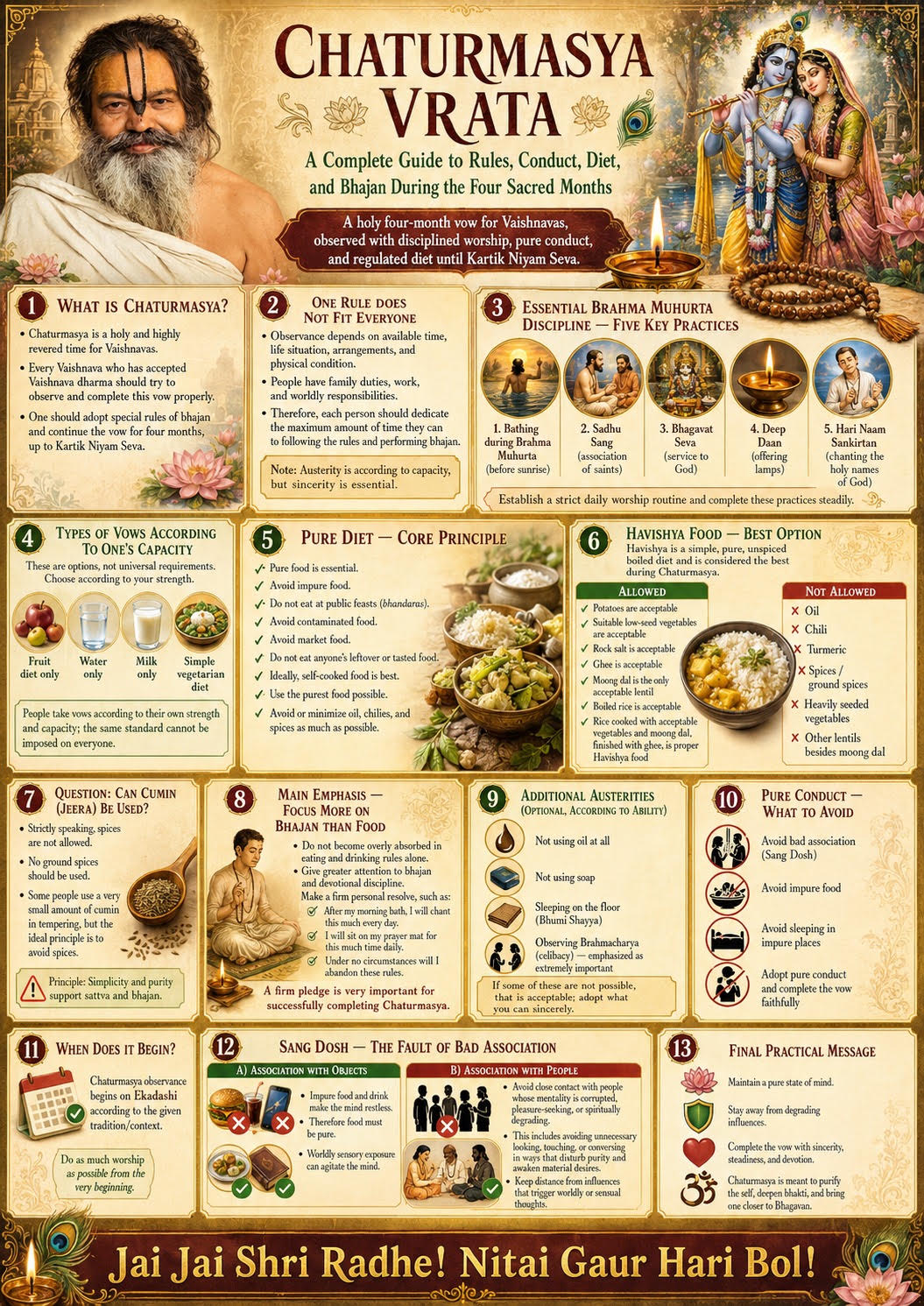
[4] Here is a practical guide to Kārttika written by a renowned contemporary Vaiṣṇava — Chaturmasa Vrata Guide.
 

Monday Morning Greetings 2026 #41 – Monday Morning Musings from Govardhan

October 12th, 2026

All You Need Is Love


I think we can basically look at relationships in three ways:


When you get more than you deserve, it’s called love. When you get exactly what you deserve, it’s called business. When you get less than you deserve, it’s called exploitation.


When sincere people come to a spiritual movement, they give their lives. Of course, in one sense, what they receive is priceless, even if they are not paid or given anything material in return. But to feel that kind of gratitude without any concrete reciprocation, one must be very evolved. I therefore think that institutions and spiritual leaders should go out of their way to give sincere people more than they expect.


This matters especially because sincere people who surrender themselves are vulnerable. They may continue serving for years, even while their physical and emotional needs are neglected in the name of service.


Here is a small example of me trying to put this realization into practice. I invited a devotee to make a presentation at my retreat. We paid for his ticket and promised him a certain honorarium. He lives as a sādhu and doesn’t have much, and I sensed that he felt neglected after years of selfless surrender. Everyone appreciated his contribution, so I told my assistant to give him more than we had promised.


It may seem like a small thing. But in a spiritual movement where people give their lives and often receive very little remuneration or support in return, I think it is important to find ways to show kindness.


Of course, in bhakti, one should never act with a motive. That doesn’t change the fact that the Śrī Upadeśāmṛta lists six loving exchanges that nourish our heart in devotion. So shouldn’t we look for ways to give to others even beyond what they expect—whether it is our teachings, a gift, some prasādam, or simply our time?


I remember living in Vṛndāvana twenty-five years ago, when many of my friends were also spending more time there. We were always exchanging thoughtful spiritual gifts, and it created such deep bonds of affection among us. If we don’t make such efforts in our community, I don’t think peoples’ hearts will feel nourished by love.


So here is a simple, sentimental request to my readers: find someone and show your affection with an unexpected gift.


All you need is love!


I can’t believe this dry, unsentimental, jñānī just said that.


Begging for the Holy Name


Everyone has their nature. In spiritual life, I thrive on regulation. I am also, by nature, a terrible traveler. Even after a minor change of scenery, it takes me a long time to get back into gear.


I have been in Vraja for over a week now, but I still feel the effects of travel, and it’s not just jet lag. I am still not happy with my sādhana. It’s 2 a.m. Then a thought comes: I have just read something where it says that we should beg for the Holy Name. Śrī Girirāja is only fifty meters from my door. Why not beg Girirāja for the Holy Name?


I set out along His inner path. I try to imbibe that mood in my chanting. I beg for the Holy Name.


Halfway around, on the Govinda Kund side, the Name becomes clear in my consciousness, or at least clearer, and a realization comes:


Isn’t taste in chanting simply hearing the Name clearly and effortlessly? Isn’t that our philosophy?


What is the second stage of chanting? Nāmābhāsa. Ābhāsa means a dim reflection. It is compared to the sun at dawn — we catch a glimpse of the sun, but it has not yet fully risen.


Nāmābhāsa is a glimpse of the Holy Name in the consciousness. It is not yet full awareness of the Name, but it is the dawning of the pure Name. The metaphor makes clear that as one advances in chanting, the Name shines ever more brightly in one’s consciousness and the taste for chanting blossoms.


But why beg for it?


Three coverings filter our perception of the Name. In the mind, the covering is inattention. In the intelligence, it is misconception. In the ego, it is our aversion to surrender. While these sheaths of resistance remain, it is not possible by our own power to fully perceive the Name through their covering. But by begging for the Holy Name, that sincerity moves the Name to take the initiative and come to us beyond the foggy mind.


So when the Name appears clearly in one’s consciousness, or even when we experience only its dim reflection, we should understand that the clear manifestation of the Holy Name, and consequent taste that comes by feeling our relationship with the Holy Name, is purely the mercy of God.


We must therefore beg for the Holy Name!


Monday Morning Greetings 2026 #40 – The Absolute Tooth II: A Medical Pilgrimage

October 5th, 2026

I was a bit awestruck by the facility. Above my chair, the dentist’s workstation had a computer screen where he could carefully monitor my root canal, using a small camera that he occasionally positioned beside my mouth. He was repairing the mistake made during my last visit to my dentist in New Jersey, and the facility today was such an upgrade. Instead of requiring multiple visits to the dentist, he would complete the entire procedure — including making and fitting the highest-grade zirconia ceramic cap — in less than two hours in one visit.


My dentist explained everything so carefully and with such authority that I trusted him. But why was I so awestruck?


I was in Vṛndāvana just a minute from MVT, at Lord Krishna’s Multispecialty Dental Clinic. Who expected that?


It was certainly a far cry from the first dentist I had seen in Vraja fifty years ago: a simple man in a lungi, sitting on the floor alongside a shop in Loi Bazaar, with a rusted quart can for rinsing one’s mouth next to a set of pliers for pulling teeth. Above him hung a rudimentary little placard with an exaggerated painted smile announcing his services.


Anyway, dental work is never fun. Yet there was still a certain joy in lying on my back, mouth wide open to the Vraja sky, realizing that I was in the lap of God — and all for the cost of only 24,000 rupees ($250) for the highest quality work!


For this week’s Greetings, I will also share a re-edited version of the original Absolute Tooth post, in which I reflect on the main realizations I had after visiting a dentist ten years ago, following too many years of neglect.


The Absolute Tooth[1]


I’ve been lying in a dentist’s chair here in Cali, Colombia, for almost two hours. Oscar is drilling away. If he hits a nerve, he says, I may need a root canal. It’s not where I want to be, but I tolerate it. Yes tolerate — what’s the use of studying transcendental knowledge if you don’t apply it to your life. So many thoughts go through my mind:


Krishna’s pinch of mercy


This last week in Shyam Ashram seemed like one of those rare, maybe never happens, occurrences in life — where most of one’s troubles are cleared and the world finally falls in line with one’s desires. My mind celebrates, “I can enjoy!”


Not so fast.


Bam! A toothache and an unexpected trip to the dentist. The prognosis wasn’t good, “Seven cavities to fill!”


I wasn’t happy to hear that, but deep down I felt some solace. Krishna won’t let His devotee grow complacent and fall into the illusion that he or she is the controller. Such enjoyment is too superficial, immerses one in the bodily concept of life and inevitably winds up in more misery.


Surrender


When I arrived, Oscar carefully explained the procedure and asked if it was okay. I told him, “I am a soul surrendered unto you!” This, I thought, is Krishna consciousness. In every sphere of life, and especially in spiritual life, some people are authorities in a particular field. The best way to benefit from their knowledge, provided they are legitimate, is to humbly surrender to their direction.


Dependence


Oscar had been one of my students in the bhakti course at Shyam Ashram. Now I sat in his chair, helpless and dependent on him. He was sincerely trying to help me and wasn’t even charging anything. I felt his care and shelter and my affection for him grew. Our relationship with God is like this. If we are completely dependent on Him and humbly take His shelter, with the faith that whatever He does is best, then bhakti naturally arises in the heart.


And whatever Krishna does is best


If I hadn’t gotten this treatment now, I would probably have needed serious dental work later in Vṛndāvana, maybe even a root canal. Considering the facilities there at the time, it could have been a nightmare. Thinking this way, even though getting seven cavities filled with no anesthesia, I felt grateful and it helped me tolerate the inconvenience. The world is like this. We suffer, but if we tolerate there is inevitably a fruit of realization at the end that makes our future better. Understanding this helps a devotee stays patient and tolerant even in hard times.


Divine austerity


When we indulge the pleasures of the body without regulation, we become ever more absorbed in the body so that we can experience sensual joy more fully. But the more we are immersed in the bodily concept of life, the more acutely we also feel the body’s pains. In contrast, when we practice the austerity of a simple life, we instinctively withdraw from absorption in the body to lessen the discomfort. And because we have learned to tolerate the discomforts that austerity brings, we naturally become less affected by bodily pain as well.


As Oscar worked away, I realized that my years of simple living, with their natural austerity, had allowed me to stand just a little apart from the pain and tolerate it. Without some tapasya, the divine austerity that arises naturally from faithfully fulfilling one’s responsibilities (dharma) and rendering service (sevā) despite the inconvenience, one remains deeply immersed in the bodily concept of life. Consequently, the dualities of this world that we must inevitably face, especially old age and disease, are felt all the more acutely.


The illusion of expectation


Expecting the drill, with its pain and its shrill whine, was worse than the drilling itself. The world is generally like that. Pain and pleasure are more intense in anticipation than when we experience them. This is especially true of sensual and egotistical pleasures.


Conclusion


And that’s the Absolute Tooth!


[1] This is a substantially edited version of an article I posted on September 19, 2016.